AI Is No Longer the Competitive Edge—AI Talent Is
Artificial intelligence has quickly become part of everyday business conversations. From automating repetitive tasks to improving customer experiences and accelerating decision-making, organisations are embracing AI at an unprecedented pace.
But as AI adoption grows, one challenge continues to stand out: finding people who know how to use it effectively.
Across Singapore, businesses are shifting their focus from simply investing in AI technology to investing in AI talent. Recent industry events, including The AI Summit Singapore and the Singapore Computer Society’s AI Conference, have highlighted a common message: organisations need people who can combine technical knowledge with business understanding to unlock AI’s full potential.
The future isn’t just about smarter technology—it’s about smarter teams.
The Skills Gap Is Becoming the Biggest Challenge
Singapore has long positioned itself as a regional technology hub, attracting global companies and startups alike. However, demand for AI professionals continues to outpace supply.
It’s no longer enough to hire software engineers or data analysts. Employers are increasingly looking for professionals who understand machine learning, prompt engineering, AI governance, automation, data strategy, and responsible AI implementation.
At the same time, AI isn’t just changing technical roles. Marketing teams, HR professionals, finance departments, customer service teams, and operations managers are all beginning to incorporate AI into their daily workflows.
According to workforce research, while confidence among Singapore employees remains relatively high, confidence drops significantly when AI-specific skills are considered, highlighting the growing need for continuous learning and upskilling.
Hiring AI Talent Means Hiring for Adaptability
One of the biggest misconceptions is that AI hiring only applies to technology companies.
In reality, organisations across industries are searching for employees who can work alongside AI rather than compete against it.
The most valuable candidates today often demonstrate:
- Strong analytical thinking
- Curiosity and willingness to learn new technologies
- Data literacy
- Problem-solving skills
- The ability to apply AI tools responsibly within business processes
Technical expertise remains important, but adaptability has become equally valuable.
Companies that prioritise learning potential over rigid experience requirements are often better positioned to build future-ready teams.
Upskilling Existing Employees Is Just as Important
Recruitment alone won’t solve the AI talent shortage.
Many organisations are finding success by developing internal talent through AI training, practical workshops, and cross-functional learning opportunities.
Employees who already understand the business often require less time to become productive with AI tools than external hires who must first learn company processes.
This approach not only strengthens workforce capabilities but also improves employee engagement and retention.
The conversation has shifted from replacing jobs with AI to enabling people to work more efficiently through AI.
Building an AI-Ready Workforce
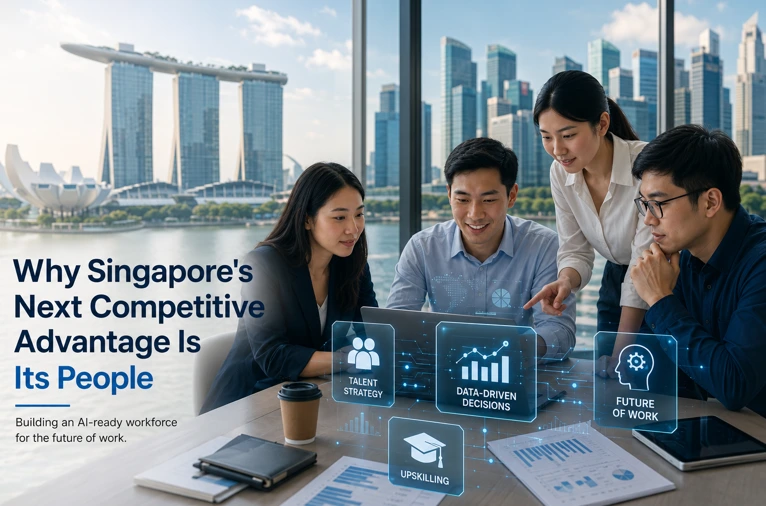
Singapore’s AI ecosystem continues to grow through collaboration between businesses, educational institutions, government initiatives, and industry events. The focus is increasingly on creating a workforce that understands both technology and business outcomes, ensuring AI delivers measurable value rather than becoming another technology investment.
For organisations, the question is no longer whether AI will transform work.
The real question is whether today’s workforce is prepared for tomorrow’s opportunities.
Companies that invest in AI talent—whether through strategic hiring, continuous learning, or skills development—will be better equipped to innovate, adapt, and compete in an increasingly AI-driven economy.
Technology may power the future, but people will continue to shape it.